
Sasa Jataka
Sasa Jataka
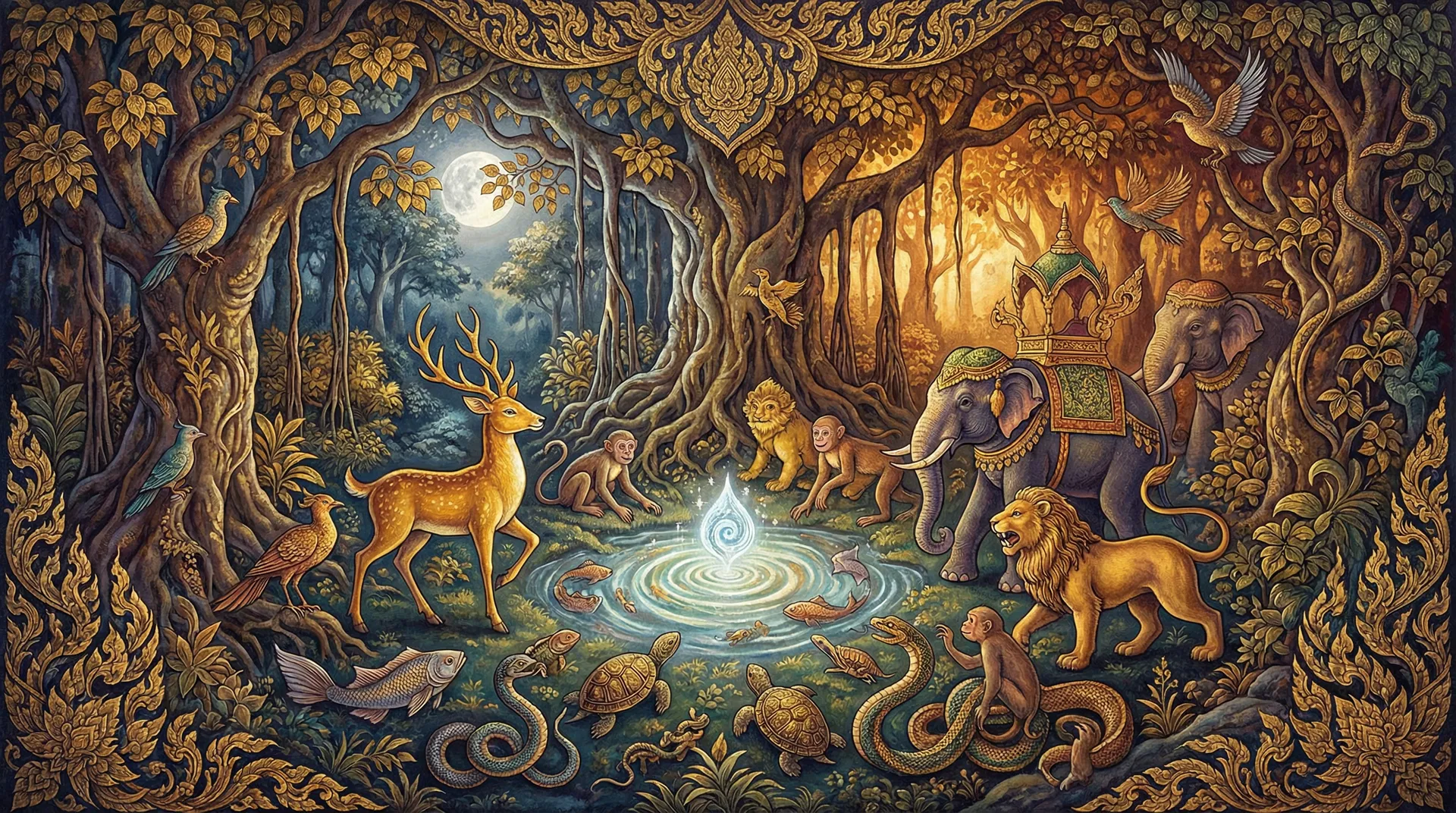
In the dappled sunlight of a vast forest, where ancient trees whispered secrets to the wind, lived a wise and noble hare. This was no ordinary hare; he was a Bodhisatta, a being of immense compassion and purity, destined for greatness. The hare lived a simple life, finding joy in the rustling leaves, the sweet scent of blossoms, and the cool water of the forest stream. He shared his humble existence with three companions: a monkey, a jackal, and an otter. They were an unlikely quartet, yet bound by a deep friendship and a shared reverence for the ethical principles they had vowed to uphold.
The hare, in particular, was a paragon of virtue. He lived by the Five Precepts with unwavering devotion: abstaining from killing, stealing, sexual misconduct, false speech, and intoxicants. His days were spent meditating on the impermanence of life and contemplating the boundless nature of compassion.
One day, a celestial being, the god Sakka, in disguise, decided to test the virtue of the forest dwellers. He descended to earth, appearing before the four friends as a poor, emaciated hermit, his form wracked with hunger and thirst. He approached them with a mournful plea, 'O noble beings, I am a traveler, lost and starving. I have not eaten for days. If you have any food to spare, I beg you, share it with me. My life hangs in the balance.'
The monkey, agile and quick, immediately scurried up a tree and brought down a cluster of ripe mangoes. He offered them to the hermit, his heart filled with eagerness to help.
The jackal, cunning and resourceful, darted away and returned with a fish it had cleverly caught from the river. It presented the fish to the hermit, hoping to alleviate his suffering.
The otter, sleek and swift, dove into the cool water and emerged with a handful of glistening pearls and a collection of savory crabs. It laid them at the hermit's feet, a humble offering.
Finally, the hermit turned to the wise hare. 'O noble hare,' he croaked, his voice weak with feigned exhaustion, 'do you have anything to offer me? My hunger is unbearable.'
The hare looked at the hermit, his heart filled with profound empathy. He knew that the hermit was truly in need, and he was determined to offer him the best he had. But he possessed no fruits, no fish, no worldly possessions. All he had was himself.
With a serene smile, the hare said, 'Revered hermit, I have no food to offer you in the way my friends do. But I have my own body, which I can freely give. If you wish to eat, please light a fire, and I shall offer myself to you.'
The hermit, astonished by the hare's selfless offer, exclaimed, 'O noble hare, how can this be? You are a creature of immense virtue. I cannot possibly take your life!'
'Do not hesitate,' the hare insisted. 'Life is fleeting, and the opportunity to help another being is precious. Please, light the fire.'
The hermit, moved beyond words, reluctantly agreed. He gathered dry leaves and twigs and, with a touch of his divine power, ignited a blazing fire. The hare, without a moment's hesitation, gathered himself and leaped into the flames. He endured the searing heat, his body consumed by the fire, offering his very being as sustenance to the supposed hermit.
As the hare’s body turned to ash, the god Sakka, shedding his disguise, reappeared in his celestial glory. He looked down upon the remains of the noble hare, his divine eyes filled with tears of profound admiration. He then took the ashes of the hare and, with his divine power, imprinted the image of the hare onto the surface of the moon. And to this day, if you look closely at the full moon, you can see the silhouette of a hare, a perpetual reminder of the Bodhisatta's ultimate act of compassion.
Sakka then addressed the other animals, 'Your gifts were generous, but the hare’s gift was supreme. He offered his own life, the most precious thing one can possess, for the sake of another. His act of selfless sacrifice and boundless compassion is an example for all beings, in all realms, for all time.'
The story of the Sasa Jataka, the hare on the moon, continues to inspire countless beings, reminding them of the extraordinary depth of love and sacrifice that a Bodhisatta is capable of, and the ultimate reward that lies in selfless giving.
— In-Article Ad —
💡Moral of the Story
Selfless sacrifice and boundless compassion are the highest virtues, offering the greatest merit and inspiring all beings.
Perfection: Generosity (Dana), Morality (Sila), Patience (Khanti), Truthfulness (Sacca)
— Ad Space (728x90) —
More Jataka Tales You May Enjoy
 473Dvādasanipāta
Kusa Jātaka
The Tale of Prince Kusa and the Golden WheelIn the opulent kingdom of Videha, ruled a king whose hea...
💡 True love and unwavering devotion can overcome even the most deeply entrenched traditions and fears. Courage and perseverance in a noble cause can lead to extraordinary achievements.
 255Tikanipāta
Sattigumba-Jātaka
Sattigumba-JātakaIn the sprawling kingdom of Kasi, renowned for its skilled artisans and vibrant mar...
💡 True magnificence and strength lie in compassion, respect for nature, and harmonious coexistence, not in dominance or possession. Righteous rule is demonstrated through justice, empathy, and the protection of all living beings.
 15Ekanipāta
The Bodhisatta as a Scholar
The Bodhisatta as a ScholarIn the hallowed halls of an ancient monastery, nestled amidst serene, rol...
💡 True wisdom is demonstrated through the compassionate application of knowledge for the well-being of others.
94EkanipātaMuni Jataka
Muni JatakaIn the verdant forests of the Himalayas, where ancient trees whispered secrets to the win...
💡 True peace and strength are found not in external conditions or material possessions, but in the stillness and equanimity of the mind, cultivated through wisdom and detachment.
 154Dukanipāta
Mātanga Jātaka
Mātanga JātakaIn the ancient city of Mithila, there lived a young woman of unparalleled beauty and g...
💡 True wisdom is accompanied by humility and compassion; superficial knowledge, when fueled by ego, leads to arrogance.
98EkanipātaThe Bodhisattva as Prince Kumara
In the magnificent city of Varanasi, under the benevolent reign of King Brahmattata, who upheld the ...
💡 True wisdom lies in understanding the consequences of actions and choosing the path of righteousness, rather than succumbing to anger, hatred, or fear.
— Multiplex Ad —